Overview.
This figure compares the dominant bioavailability barriers and formulation strategies associated with ral and non-oral drug delivery routes. While oral administration remains the most patient-preferred route, it imposes multiple sequential physiological and biochemical barriers. Non-oral routes bypass some or all of these constraints but introduce distinct formulation, distribution, and safety considerations. The relevance of each route is strongly dependent on molecular class, particularly for biologics.
Panel A: Oral delivery
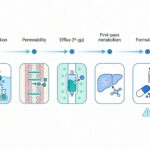
Oral administration subjects drug molecules to a cascade of barriers before systemic exposure, including dissolution in gastrointestinal fluids, chemical and enzymatic stability, epithelial permeability, efflux transport, and presystemic metabolism. For small molecules, bioavailability is governed by the balance between solubility and permeability, whereas for biologics, enzymatic degradation and size-restricted transport dominate.
Formulation strategies for oral delivery are therefore multifactorial, aiming to:
- Enhance dissolution and apparent solubility (hydrophobic small molecules)
- Improve epithelial permeability (hydrophilic small molecules)
- Protect labile molecules from degradation (peptides, nucleic acids)
- Modulate absorption kinetics to reduce first-pass hepatic extraction
Despite significant advances in formulation science, oral bioavailability remains highly variable and often inadequate for large, polar, or enzymatically labile molecules, particularly peptides and polynucleotides.
Panel B: Parenteral delivery (intravenous and subcutaneous)
Parenteral administration bypasses the gastrointestinal tract and first-pass metabolism, resulting in complete (IV) or predictable (SC) systemic exposure. For IV dosing, bioavailability is defined as 100% by convention, shifting the primary pharmacokinetic determinants to distribution, metabolism, and elimination.
Subcutaneous administration introduces additional barriers, including:
- Depot formation at the injection site
- Lymphatic uptake for large or lipophilic molecules
- Enzymatic degradation in interstitial tissues
Nevertheless, parenteral routes remain the dominant delivery mode for biologics due to their reliability and controllability.
Panel C: Mucosal non-oral delivery (intranasal, pulmonary, buccal)
Mucosal delivery routes partially bypass hepatic first-pass metabolism and offer rapid systemic or localized exposure. These routes reduce enzymatic burden relative to the gastrointestinal tract but impose constraints related to:
- Limited absorptive surface area
- Mucociliary clearance
- Molecular size and formulation tolerability
They are most suitable for potent small molecules and selected peptides, with formulation strategies emphasizing mucoadhesion, particle engineering, and controlled deposition.
Panel D: Transdermal delivery
Transdermal delivery avoids gastrointestinal degradation and first-pass metabolism but is constrained by the stratum corneum, a highly effective permeability barrier. Only small, lipophilic, and potent molecules are amenable to passive transdermal delivery.
Advanced systems, including microneedles and active enhancement technologies, have expanded applicability, particularly for peptides and vaccines, though formulation complexity increases accordingly.
Panel E: Intracellular delivery routes for polynucleotides
For nucleic acid therapeutics, bioavailability is route- and formulation-dependent and extends beyond systemic exposure to include cellular uptake and intracellular trafficking. Parenteral delivery combined with carrier systems (e.g., lipid nanoparticles) enables protection from degradation, tissue targeting, and endosomal escape.
In this context, bioavailability is best conceptualized as functional delivery to the intracellular site of action, rather than plasma pharmacokinetics alone.
Comparative summary
| Route | Key Advantage | Primary Limitation | Best-suited Modalities |
| Oral | Patient compliance | GI degradation, first pass metabolism | Small molecules |
| Parenteral | Predictable exposure | Invasiveness | Biologics |
| Mucosal | Rapid onset | Limited capacity | Potent small molecules |
| Transdermal | Sustained delivery | Skin barrier | Lipophilic APIs |
| Intracellular (via carriers) | Targeted action | Delivery complexity | Polynucleotides |
Conclusion.
The optimal delivery route is dictated by molecular properties, therapeutic index, and target site of action. While oral delivery remains desirable, non-oral routes are essential for overcoming bioavailability barriers inherent to biologics and complex modalities. Modern drug delivery increasingly integrates route selection and formulation design as co-dependent determinants of clinical success.