Bioavailability, in simple terms
Bioavailability describes how much of a drug or active compound actually reaches your bloodstream and can start working. You may swallow a full dose, but your body often absorbs only a part of it. In many cases, only a small amount enters circulation.
Think of it like sending a package:
- You ship 100 units
- Some get damaged
- Some get lost
- Some are stopped at customs
Only what arrives matters. The same idea applies to bioavailability.
Why are some compounds hard to absorb
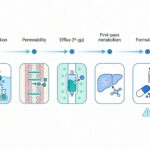
The human body protects itself very well. Because of that, it blocks many substances before they reach the bloodstream. Several barriers stand in the way, and each one reduces absorption in its own way.
1. Poor solubility (won’t dissolve well)
Many active compounds:
- Don’t dissolve well in water
- And your gut is mostly water
If a compound can’t dissolve, it can’t be absorbed — it just passes through.
No dissolution → no absorption → no effect
This is one of the most common problems in drug development.
2. Large or complex molecules
Some molecules are:
- Too large
- Too structurally complex
- Too “bulky”
Because the intestinal wall is selective, only certain molecules can pass through it. When a compound is too big or too complicated, its absorption drops sharply.
3. Chemical instability
Some compounds break down before they even reach the intestine. They may:
- Degrade in stomach acid
- Be destroyed by digestive enzymes
By the time they reach the intestine — where absorption actually happens — they may already be degraded.
4. First-pass metabolism (the liver effect)
Even when a compound enters the bloodstream from the gut, another barrier appears. Blood from the digestive tract flows directly to the liver, which acts as a chemical filter.
The liver may break the compound down right away. In some cases, it inactivates most of the dose before it reaches the rest of the body. This process is known as first-pass metabolism, and it often lowers the effectiveness of oral drugs.
5. Efflux pumps (the body actively pushes it out)
Cells in the intestinal lining contain efflux transport proteins whose job is to eject foreign substances.
- They literally pump some drugs back into the gut
- Even after absorption has begun
From the body’s perspective, it’s a defence.
From the drug’s perspective, it’s sabotage.
For a more detailed explanation of bioavailability and oral bioavailability in pharmacokinetics, see the article on Wikipedia.
For a practical look at how modern formulation science improves oral bioavailability and solves real‑world absorption barriers in drug products, see our follow‑up article: How Modern Formulation Science Solves Bioavailability Challenges.
For readers who want more depth and scientific context on drug absorption, gastrointestinal absorption and ADME processes, our RD Blog covers these topics in greater detail.